







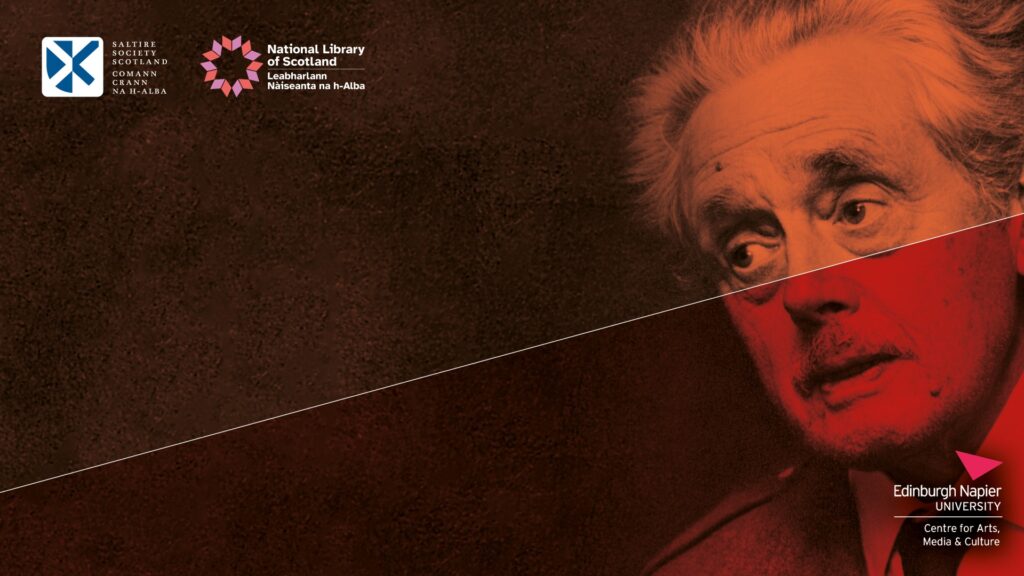
A major cultural conference reassessing the life, work and contested legacy of Hugh MacDiarmid, arguably the most Influential Scottish writer of the last 100 years, will take place at the Glasgow Royal Concert Hall on Saturday 21 November 2026.
Held on the eve of the centenary of MacDiarmid’s poem A Drunk Man Looks at the Thistle, the event will explore the controversial “MacDiarmid effect” on Scottish culture and the development of a national movement.
Hosted in partnership with the Saltire Society, the National Library of Scotland, the Centre for Scottish & Celtic Studies, and Edinburgh Napier University, the event offers a full day of debate, performance and reflection. Its focus extends beyond MacDiarmid’s best-known poem to his role in the Scottish Renaissance, his invention of “Synthetic Scots” as a national language, his influence on ideas of Scottish identity and the political extremes that continue to complicate his reputation.
Published on 22 November 1926, A Drunk Man Looks at the Thistle remains a work of startling ambition: 2,685 lines of cosmic argument, lyrical invention and abrasive humour, written in a Scots that reached back to Dunbar and forward to the modernist movement of the twentieth century.
A younger generation of Scots may now have forgotten him, but – for better and worse – they live with his legacy. Across poetry, journalism, criticism and nationalist politics, he helped reshape Scottish culture and revolutionised ideas about nationhood, the Scots language, and Identity. His brilliance, absurdity, extremity and inconsistency demand fresh scrutiny.
MacDiarmid helped found the National Party of Scotland in 1928 but, as his Marxist-Leninist commitments sharpened, went on to denounce the SNP in the 1930s. He joined the Communist Party of Great Britain in 1934, was expelled in 1938 amid conflict over his nationalism, and later rejoined it in 1956. Alongside this sustained communist allegiance, his record includes admiration for aspects of authoritarian politics. These positions sit uneasily beside his anti-imperialism and revolutionary socialism. Confronted by his contradictions, his response was to cite Walt Whitman:
“Do I contradict myself? Very well then I contradict myself, I am large, I contain multitudes.”
Alexander Linklater, MacDiarmid’s biographer and co-organiser of the event, said:
“Hugh MacDiarmid was the most influential, argumentative and enigmatic Scot of the last hundred years. His extremist personality and preposterous politics were a front, behind which the real Christopher Murray Grieve remained hidden.
The “MacDiarmid effect” was a catalyst, rousing other influential Scots to take up the argument. From the obscure origins of the “Scottish Renaissance” of the 1920s to the creation of a disputed literary canon to the moment in May 2015, when Alex Salmond marched 56 triumphant SNP MPs into the House of Commons – all wearing the “MacDiarmid Rose” – he comes down to us less as a historical figure than an idea in the minds of others.
This event is not designed to celebrate the Drunk Man’s mad theories but to have the argument and recognise the work. Even with nationalism in crisis, MacDiarmid’s poetry stands out as the most extraordinary and enduring legacy of the Scottish movement.”
Presented by Sally Magnusson, the programme opens with Sir Tom Devine on the Scotland of the 1920s, followed by a roundtable featuring David Torrance, Murray Pittock, Pat Kane and Gerda Stevenson, debating the origins of modern Scottish nationalism.
Performances by Maureen Beattie and W.N. Herbert bring the Drunk Man’s dialogue to life, while major figures of Scottish scholarship consider the poem’s place in national and international literature. Deirdre Grieve offers personal memories of Christopher Murray Grieve, the man behind the MacDiarmid persona, and Patrick Crotty introduces the new Complete Collected Poems. The day concludes with a conversation on the fate of the National Movement in the last decade.
The conference will ask how MacDiarmid’s literary innovation, cultural nationalism and ideological extremes should be understood in today’s culture. It will consider the breadth of his poetry, his influence on later writers and politicians, and the responsibilities involved in commemorating a major artist whose public positions included both brilliant and objectionable ideas. The ambition is a fuller, more candid reappraisal of MacDiarmid’s place in Scotland’s story.