







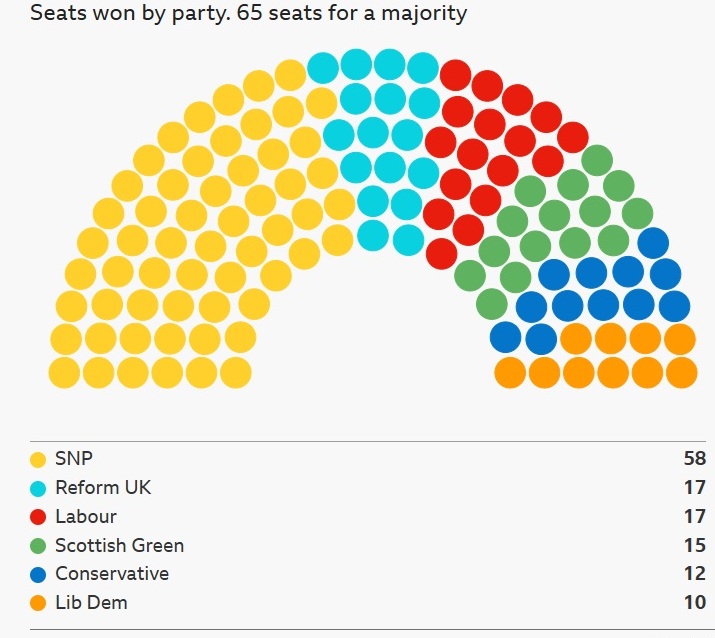
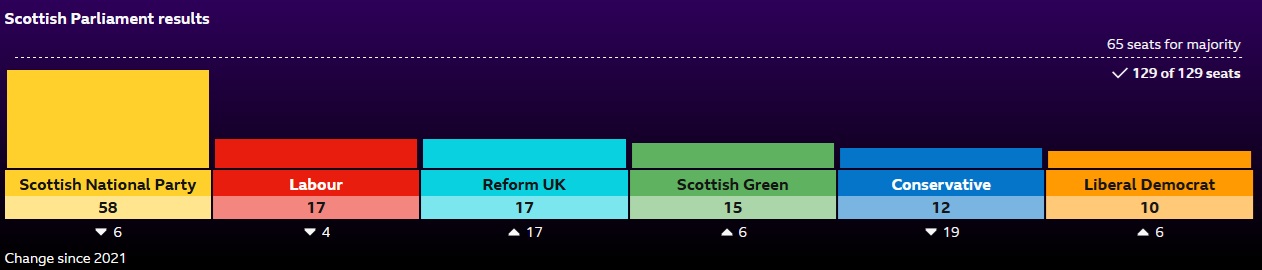
The SNP has defied gravity and won a fifth successive Scottish Parliament election, but fallen short of its target to achieve an overall majority of 65 seats, returning 58 MSPs.
Scotland Results
It is, however, a remarkable result for a party that has been in power for almost two decades and seemed down and out following the UK Parliament election in 2024. The SNP have finished miles clear of a hopelessly fractured pack of opposition parties, delivering a pro-independence majority (with the Greens) of 73 MSPs.
Labour came a very distant second, with 17 MSPs, tying with Reform UK, which has made its electoral breakthrough in Scotland.
The Scottish Greens won a record 15 seats, including their first-ever constituency victories in Glasgow and Edinburgh, taking seats from the SNP. This included the ousting of SNP veteran, Angus Robertson, in Edinburgh Central and the gaining of Nicola Sturgeon’s former seat of Glasgow Southside.
The Conservatives lost their position as the parliament’s largest opposition party, suffering their worst-ever Holyrood election result, finishing with 12 seats. This included the loss of Eastwood, the seat of Tory veteran Jackson Carlaw, to the SNP.
The Liberal Democrats, meanwhile, returned 10 MSPs, including gains in Edinburgh Northern, Strathkelvin and Bearsden, and two former SNP Highland seats. This included Kate Forbes’ former seat of Skye, Lochaber and Badenoch.
Reform UK’s success, fracturing the unionist vote, helped the SNP return a swathe of constituency seats, despite their share of the vote declining by almost 10 per cent since 2021.
Promising tax cuts and action to curb immigration, it had never had an MSP elected before – previous MSPs had defected from other parties.
Results for the Constituency and Regional Lists can be found here.
What does this mean for Scotland?
The SNP will run as a minority administration, relying on help from other parties to pass legislation and reinstall Swinney as first minister.
Labour and the Conservatives are each in a desperate position, with the former having lost seats at every Holyrood poll since 1999 and the latter scoring their worst ever result.
One suspects Anas Sarwar will still lead the party, in the short to medium term at least. A period of reflection is anticipated, with more pressure heaped on Prime Minister Starmer due to the result.
Reform UK have pledged to “shake up” the parliament, and their introduction will be interesting, with a raft of unknown faces. Having sparked frequent confrontations and fiery rhetoric during the campaign, they may have a similarly explosive impact on the new parliamentary term.
The Scottish Greens and Liberal Democrats will also want to make their mark.
John Swinney has the potential to fully shape this administration, and he has already indicated this by focusing on tackling the cost-of-living crisis and growing the economy. He has also talked of a more co-operative approach in working with the UK Government.
The First 100 Days
In its 100 Days paper, published in April, the SNP outlined its intention for a new administration to “hit the ground running”.
This includes:
- Establishing a First Homes Fund, giving up to £10,000 in support to first-time buyers, will be up and running. The aim is to help 2,000 families within this period.
- Publishing draft legislation to implement a price cap on essential items to be in place by the end of the year. This will, however, require the consent of the UK Government.
- Extending the £2 bus fare cap to Glasgow, Ayrshire, Dunbartonshire, Renfrewshire, Lanarkshire and Inverclyde.
- Opening at least five more GP walk-in clinics and announcing the location of 14 more.
- Setting out additional investment to reduce waiting times and waiting lists and deliver 50,000 operations and procedures.
- Beginning consulting on legislating on phone-free classrooms. Work with education authorities to update guidance to encourage a ban to take place from the start of the new school year in August.
- Publishing a draft Referendum Bill on Scottish independence. Expect this to be rather watered down, given the SNP’s failure to secure an overall majority.
How can Orbit help with a new government?
As we begin analysing, interpreting, and breaking down these results, our Public Affairs team is already opening engagement opportunities for our clients across various sectors.
A new government is a perfect time to begin a new period of strategic engagement, and Orbit Communications is ready to support you in this endeavour.
Our Public Affairs team are experts at:
✍ Translating what Scottish political news and policy developments mean for clients
🏹 Targeting and securing meetings with the most effective stakeholders to relay your concerns and policy priorities.
🗺 Navigating and advising on devolved policy areas.
🎥 Identifying ‘rifle shot’ media and political developments; articulating context and identifying calls to action.
🗣 Giving experienced, proven guidance and counsel during times of intense political and economic change.
➡ Working with clients to deliver their message across sectors as diverse as health, renewables, energy infrastructure, construction, asset land management, luxury leisure and more.
Say hello@orbit.scot to discuss how we can help.